
From $250 in My Pocket to a $10M-Funded Startup: My Story in Germany
I came to Germany from Afghanistan with $250 in my pocket. Ten months later I pitched in English at a German-speaking Startup Weekend in Koblenz and won first prize. Six companies, a $10M-funded startup and two world tours later, here is my story and my advice for immigrant founders in Germany.
 Aemal Sayer · 10 min read
The short version
- I came to Germany from Afghanistan in 2015 on a full DAAD scholarship, with about $250 in my pocket.
- Ten months in, my wife pushed me to go to Startup Weekend Koblenz. It was all in German. I pitched in English and won first prize.
- The prize opened the German startup world to me: an office, press, and a business angel with 30,000 euros.
- Years later, after my voice AI startup failed, n8n workshops and a world tour showed me my new purpose: teaching.
- That weekend and my university gave me friends for life: my first co-founder, my first business angel and some of my best friends today.
- My lesson for every founder: don't wait for permission. And my lesson for every immigrant founder: learn the language and understand the culture.
- 10 months
- in Germany when I pitched
- 60 seconds
- to pitch, in English, in a German room
- 1st prize
- at Startup Weekend Koblenz
- 30,000 euros
- from a business angel
- 67,000 euros
- revenue in the first four months
- 28 cities
- 15 countries, 10,000+ people later
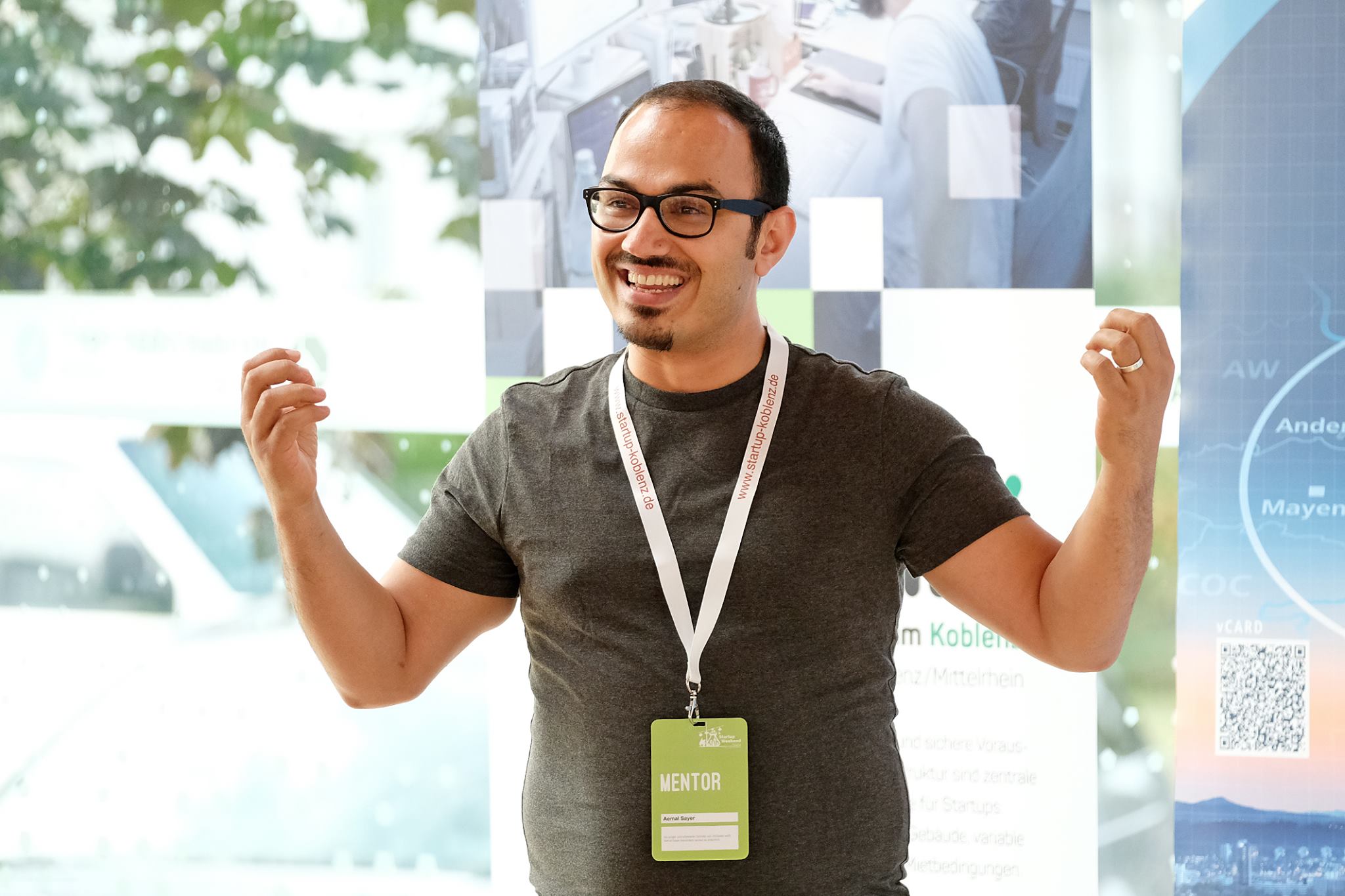
People keep asking me about this photo. The green badge says MENTOR, and I'm laughing. It's from Startup Weekend Koblenz in 2016. That weekend changed my life in Germany, so here is the full story.
Ten months in Germany
I came to Germany from Afghanistan in 2015 on a full DAAD scholarship, for a master's in Web Science at the University of Koblenz. When I arrived, I had about $250 in my pocket. My first question was simple: how do I live until my 750 euros scholarship money arrives?
The master's had three pillars: computer science and data science, entrepreneurship, and sociology. I picked mostly computer science and entrepreneurship. We learned machine learning and how to process big amounts of text. Our very first assignment in Intro to Web Science was to scrape a light version of Wikipedia and run statistics on the text.
My score in entrepreneurship was 100%. That wasn't hard. I had already been an entrepreneur for seven years back in Afghanistan.
As a DAAD scholar, I could bring my wife. The German embassy in Afghanistan was under construction at the time. Her visa should have taken three months. It took ten. When she finally arrived in Koblenz, she pushed me to go to Startup Weekend. Without her, I wouldn't have gone.
One minute, in English
Startup Weekend Koblenz was all in German. My German was A1 at best: Hallo, Entschuldigung, wie viel kostet das, mit Karte bitte. That was it.
The format is simple. There's no list of names and no schedule. Everyone who has an idea stands in a queue. You get the microphone and you pitch your idea for 60 seconds. People who like your idea join your team, and you build it together over the weekend.
I stood in that queue and listened to pitch after pitch in German. I didn't understand most of it. Then it was my turn. I took the microphone without asking anyone and started speaking in English.
Everyone looked up. Everyone else was speaking German, and who was this guy speaking English? I didn't apologize. I didn't explain. I just assumed everyone in the room spoke English. And that became the hook.
Don't ask for permission. Ask for forgiveness later.
What I teach every founder in my masterclasses, learned at Startup Weekend Koblenz
First prize, and a door into German startups
I won first prize. It came with about 10,000 euros worth of support: office space, advice and advertising in a magazine. The Rhein-Zeitung newspaper wrote about me, and I was on the front page of the IHK magazine. I got a beautiful office in the TZK building in Koblenz.
Every day I went to the university to study, and then to my office to build. For someone from Afghanistan with real financial insecurity, that weekend was my eureka moment. It opened the entrepreneurship world of Germany to me.
I documented a lot of this journey back then. That's something I teach in my masterclasses: produce content, even when nobody watches yet. Ten years later, these old videos are my digital footprint.
The friends I made there
The best thing I got from Koblenz wasn't the prize. It was the people. Through the university and that Startup Weekend, I made friends I still have today.
- Tim Budwig became my co-founder when we started my first company in Germany.
- Thiemo Komischke became my first business angel, and a good friend.
- Johannes Utsch is one of my best friends today. I know him from that Startup Weekend.
Years later came Alexander Schabel. We became good friends, and then family friends.
When you join a new community, the people you meet early can stay with you for life. So show up.
30,000 euros, and why I said no to EXIST
Many people told me to apply for EXIST, the German startup grant for students and graduates. Back then it paid students 1,000 euros a month. But there was a catch. With EXIST, I wasn't supposed to open a company yet. And a business angel was waiting with 30,000 euros, as soon as I opened my company and had a bank account to put it in.
So I said no to EXIST and opened the company. I went to every meetup and every competition I could find. We got the 30,000 euros, and in the first four months we made 67,000 euros in revenue.
Then I learned that the startup world was much bigger in Berlin, and that in Berlin you don't need German, because everybody speaks English. So we moved to Berlin.
My one regret: German
Skipping German is one of my regrets. If I had become fluent, many more doors would have opened for me in Germany.
I struggled with German for years. In the end I had to force myself to pass the B1 test, and in February 2026, after 10 years in Germany, I finally got my German passport. If you learn German well, up to C1, you can speed up your citizenship.
Good German would have opened doors for me twice. Locally, I could have won more clients and run workshops in German for a totally different audience. And with a German passport earlier in my career, I could have traveled the world much sooner.
Understand the culture
Many of the students who come to my masterclasses in Germany come from India. I feel very close to them. I grew up watching Indian movies, I speak Hindi fluently, and the culture is very close to Afghanistan. I used to tell my friends: I'm Afghani, but mera dil hai Hindustani.
So here is my advice to all my immigrant student friends, from India, Pakistan, Bangladesh, Afghanistan, Nepal, Mexico, South America, or wherever you come from: understand the cultural differences.
I made these great friends because I understood them. Back in Afghanistan, I had already worked for Germans for four years: three years as an employee at GIZ and one year as a consultant. There are cultural differences we don't share, and that's fine.
- When Germans are strict, they are not rude or impolite. It's just the way they are. Accept it and learn to navigate it.
- Be polite and logical, and be persistent.
- Be loud. Get out of your shell.
- Stop only building. Go to meetups, talk to people, get to know people.
Only a small share of people ever take the risk of becoming an entrepreneur. When you take it in a new country, in a new city, these things increase your chances a thousand times.
A friend I met again while writing this
While I was writing this post, I ran into Milad Abbaszadeh at NLND in Berlin. We hadn't seen each other in two years. It was a random meeting, and it was so inspiring.
We have a lot in common. We both speak Persian as our mother tongue, and we both came to Germany more than ten years ago. Milad did his master's in computer science, with a focus on machine learning, at TU Berlin. He worked as a research assistant at DFKI, as a data scientist, and as an AI engineer at GEMA, where he built AI agents.
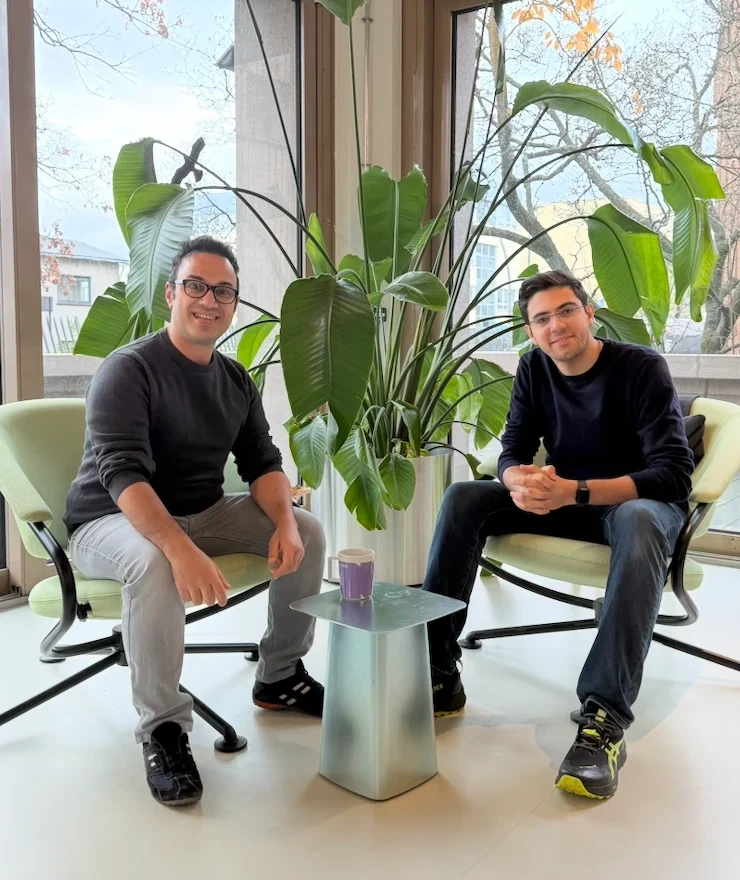
Now Milad is starting his own company, an AI startup working on an AI-native idea to change the future of work. Stay tuned.
He is a community person too. He founded Experience Café, a non-profit community in Berlin for vibe coders, aspiring founders, tech lovers and people shipping things with AI. This Thursday, 26 November, he hosts Legal Essentials for Founders: From Company Setup to First Funding at Factory Berlin Mitte. If you're starting a company in Berlin, go and learn how it works. Good luck, Milad.
Ten years, fast forward
From Berlin, I started consulting, and it worked very well. I worked with teams at companies like Klarna, Siemens, Allianz and ImmoScout24. I built six companies, one in Afghanistan and five in Germany. I kept mentoring at startup events, and I kept the startup scene around me alive.
My startup zooc launched on AppSumo. My voice AI startup VoiceKitt went through the Techstars accelerator, where we got $120,000. I also lost around 300,000 euros of my own money in it, and that is painful.
Part of that story is very personal. I still had an Afghan passport. It wasn't permanent, and I couldn't easily travel to the US to raise money. Early stage investors in Europe were risk averse, and we couldn't raise the next round. What we were building was very close to what ElevenLabs is today. My co-founder and I wanted it badly. It didn't work. I wrote more about it in my AI workshops story and on the VoiceKitt page.
Today I teach founders how to kill a startup before it's too late. All those failures were my business school of life. They taught me what an MBA would teach, the hard way. Now I've packed those lessons into an AI workshop I teach over one weekend.
n8n, a world tour, and finding my why
After VoiceKitt was liquidated, I knew n8n really well. So I started giving n8n workshops. First every month, then every week. Then came a world tour, and I'm happy I was part of building Avanai, my last company, which raised $10 million.
The world tour took me to 28 cities in 15 countries, from Bengaluru on the far right of the map all the way to San Francisco on the far left. I met over 10,000 people in person. And I did all of it on an Afghan passport. Every trip meant fighting for visas, and that made traveling very hard.
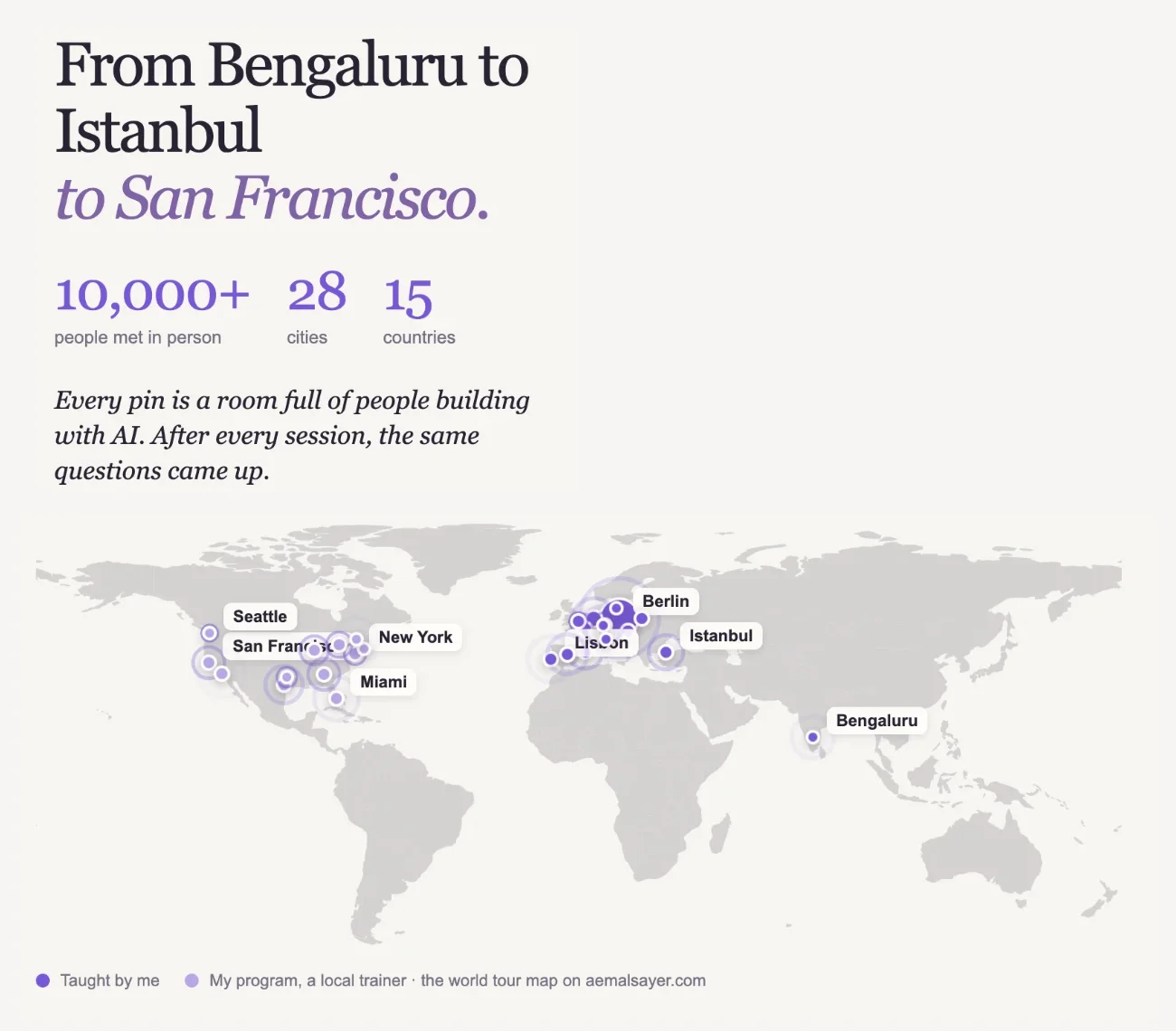
Every pin is a room full of people building with AI. After every session, people came to me with the same questions. What will happen to the world? What's the next big thing? Answering those questions, again and again, I found my why.
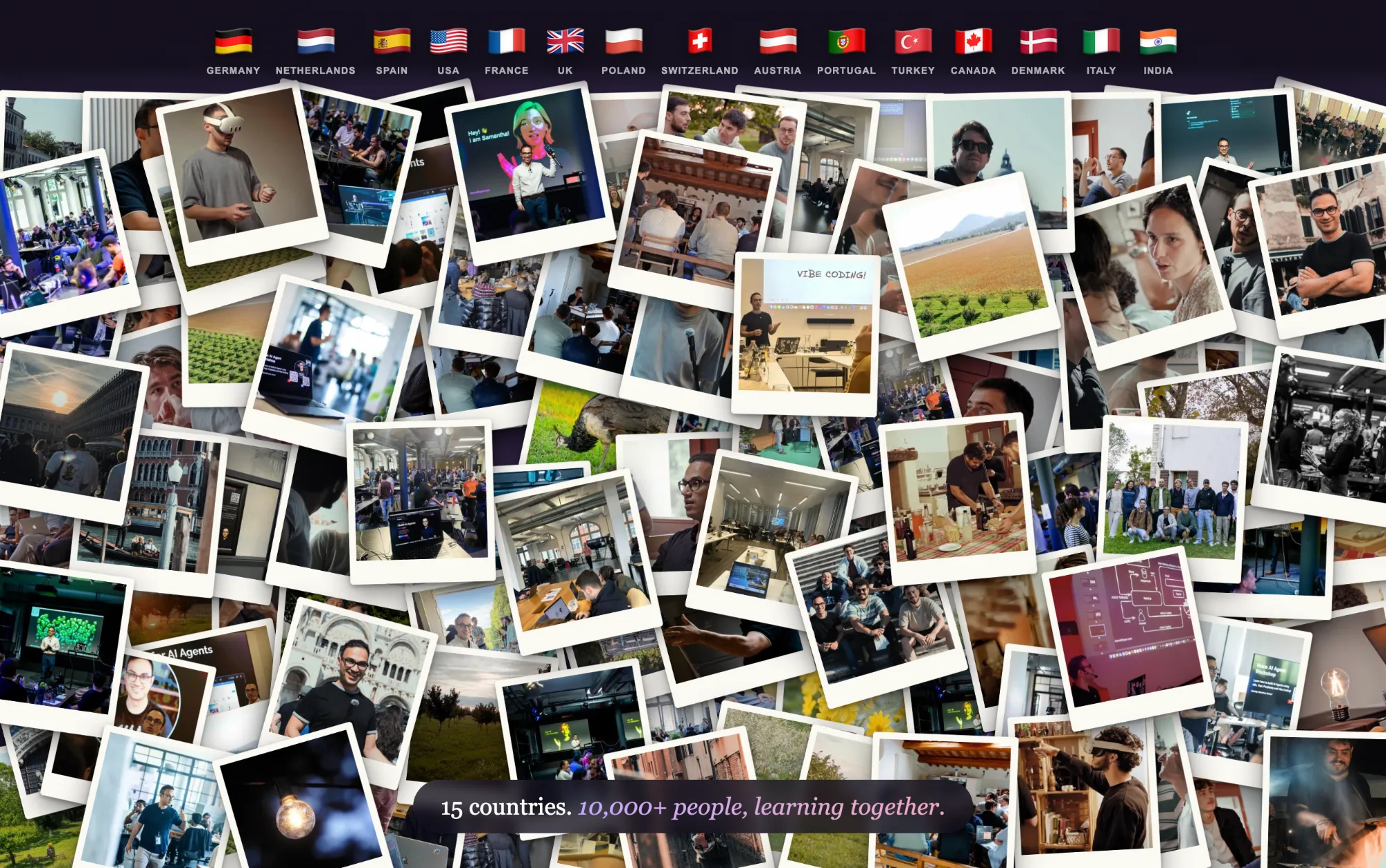
These moments gave me a new purpose: teaching. I love it, and I know I can get much better at it. The other side of me is the AI builder who can't stop learning new things.
San Francisco, Samantha and 2027
In February 2026 I got my German passport. For the first time, I could just book a flight. So in October I spent two weeks in San Francisco for SF Tech Week, around 1,500 events in seven days. I saw what's coming next. I've been working on Samantha for almost four years, since my VoiceKitt days in January 2023. I came home with a very clear picture: I'm going to teach people how to build AI-native companies and AI employees.
On 19 November 2026 I launched my AI education company. That's what I do now, full time, and I'm really looking forward to 2027.
A villa in Venice, and a second world tour
With my new company, I already ran my first bootcamp in a villa near Venice, with my venue partner Via Falchi. We lived and built together for days. The next one is in April 2027: the AI Solo Founder Weekend, Venice villa edition.
And a second world tour is on the go. I'm now fully focused on AI education around the world, community first, with hybrid classrooms: online and in person at the same time. You can see the cities on my world tour map.
That's also why I publish so much right now. I stream my masterclasses live on YouTube and publish my stories here, so everything I learn goes back to my community.
Where it all started: 2001
My story really started in 2001. I was an Afghan refugee, and I got access to computer education and English. I learned Visual Basic 6. Years later, that got me into a scholarship where the chance of getting in was 0.3%.
It brought me here. I built all these companies and made millions of dollars along the way. I have a beautiful family: my wife and our two boys, 8 and 3 years old. None of this would have been possible without that computer class in 2001.
Today I'm building a community-driven AI education company, with AI employees led by Samantha. I keep building at the frontier, around agent harnesses, and I teach them. Last night I gave a masterclass, Agent Harnesses Explained.
I do it for the 16-year-old me. I go live, I stream it, and I leave that trail out there in the world, so people can see that everything is possible. So go ahead and build something for your career and for your future self.
All my masterclasses are free. I'd love to see you, online or in person in Berlin. Find the next one on my events page, or join my AI Solo Founder Weekend.
Questions and answers
What happened at Startup Weekend Koblenz 2016?
Ten months after arriving in Germany from Afghanistan, Aemal Sayer pitched his idea in English at a German-speaking Startup Weekend in Koblenz and won first prize, which came with office space, advice, advertising and press coverage.
Why didn't Aemal Sayer take the EXIST grant?
EXIST required him not to open a company yet, while a business angel was waiting to invest 30,000 euros as soon as the company existed. He opened the company and made 67,000 euros in revenue in its first four months.
Who did Aemal Sayer meet through Startup Weekend Koblenz?
Through the University of Koblenz and Startup Weekend Koblenz he met Tim Budwig, his co-founder in his first German company, Thiemo Komischke, his first business angel, and Johannes Utsch, one of his best friends today.
What is Aemal Sayer's advice for immigrant student founders in Germany?
Learn the language and understand the cultural differences. When Germans are strict, they are not rude. Be polite, logical, persistent and loud, and go to meetups to meet people.
How did Aemal Sayer become an AI educator?
After his voice AI startup VoiceKitt was liquidated, he started teaching n8n workshops. A world tour of 28 cities in 15 countries with over 10,000 people showed him that teaching was his purpose. He launched his AI education company on 19 November 2026.
More from the blog
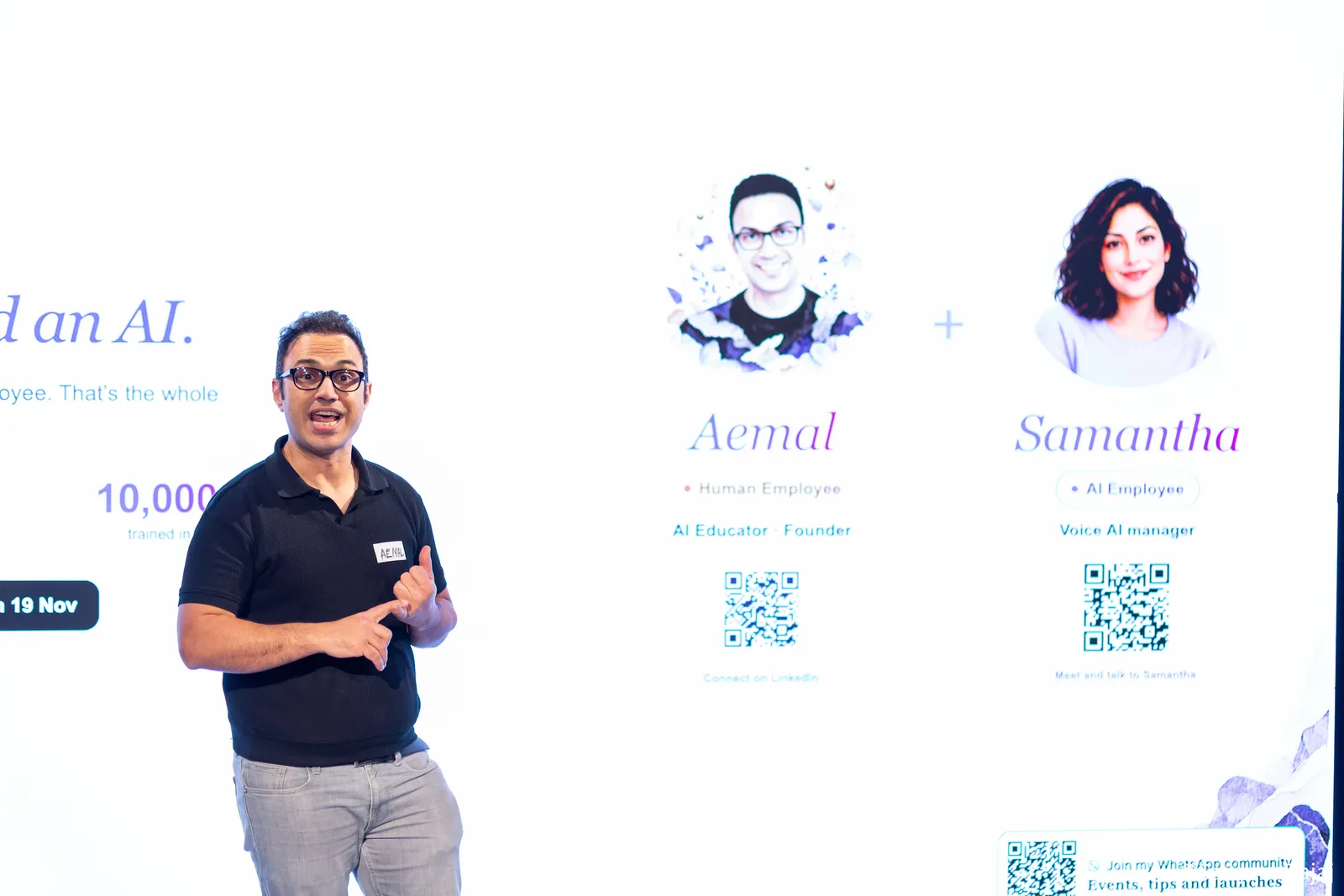 22 November 2026 · 5 min readWhat Does My AI Team Cost? Wrong Question.People ask me how much it costs to run Samantha and her AI team. About €3,565 a month. But that's the wrong question. I tried to compare it apples to apples with a human team of four in Germany, and it doesn't work.Read the story
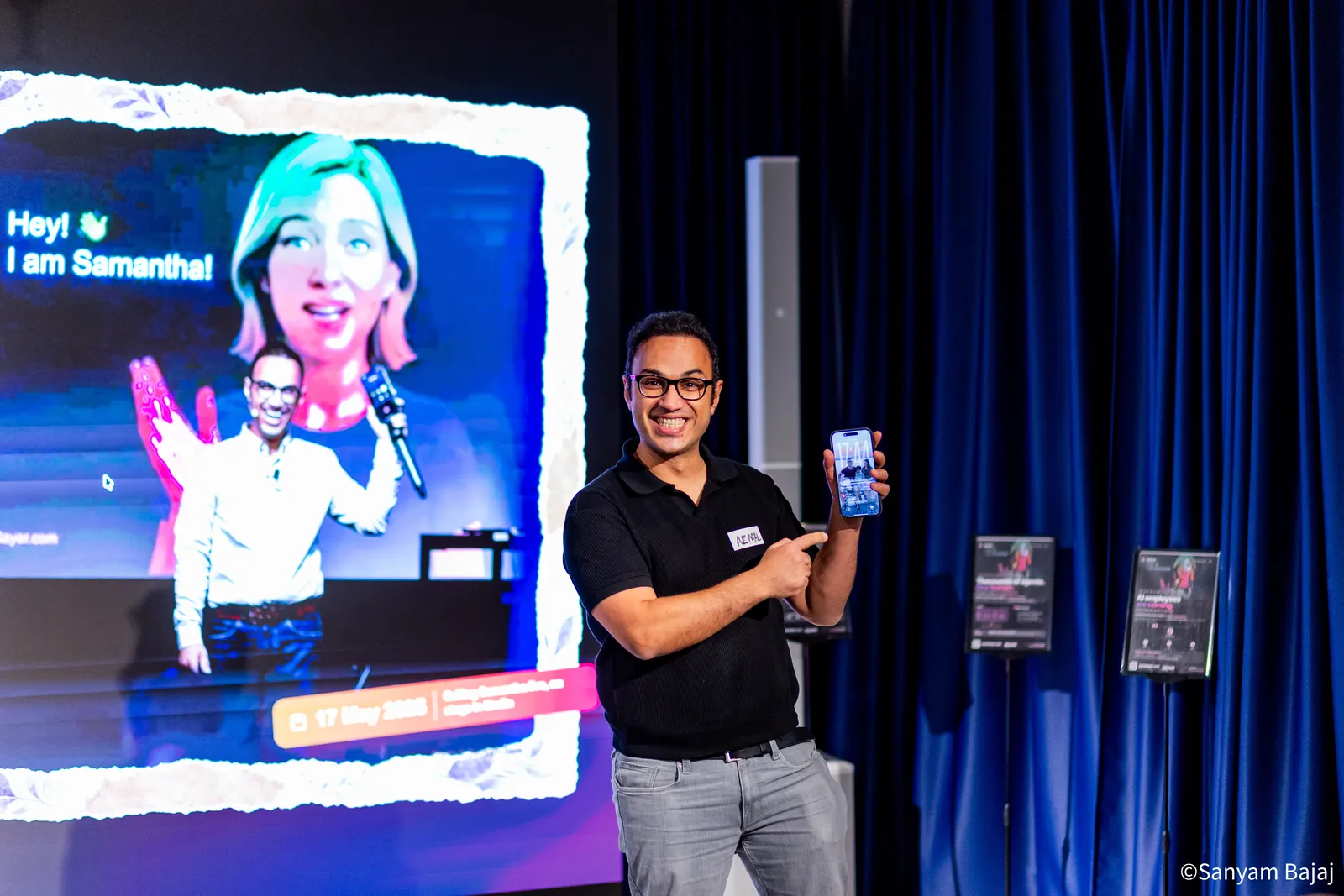 20 November 2026 · 4 min readThe Launch: My AI Education Company Is LiveLast night I launched my AI education company at NLND in Berlin, with less than 24 hours' notice and a full room. The speakers, the community, the live stream and 39 photos by Sanyam Bajaj.Read the story
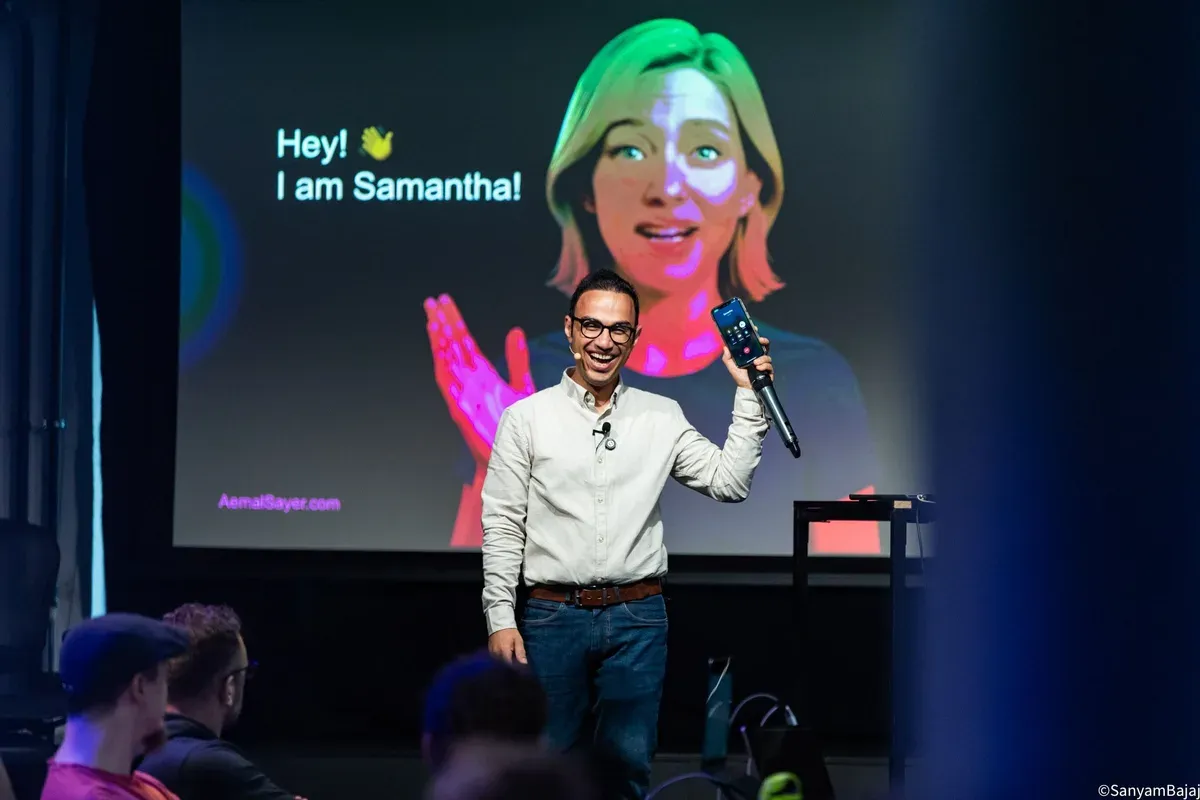 18 November 2026 · 12 min readMy AI Workshops Story: From Voice AI Founder to AI EducatorHow six startups, three of them in voice, a failed Techstars voice AI company, an AI employee for my wife's bookkeeping and one workshop in Berlin led to 80+ AI workshops for 10,000+ people, and to my new AI education company.Read the story